

Before you pay a renovation company anything, check three things: whether it is allowed to work on your home, whether it is accredited, and whether it is a real, registered business. The numbers show why. In 2025, the Consumers Association of Singapore (CASE) received 787 complaints about renovation contractors, and consumers lost about S$190,667 in prepayments.
That is real money, and a few free searches before you sign can keep yours out of next year’s figures.
This guide shows you how to choose a renovation company in Singapore using ten checks, ranked from most important to least. Each one tells you what to ask for and where to confirm it yourself. Get through the first three, and you will already be ahead of most homeowners.
10 Checks To Run Before Hiring A Renovation Contractor In Singapore
Here are all ten checks in one view. The sections after the table explain each one, starting with the checks that protect you most.
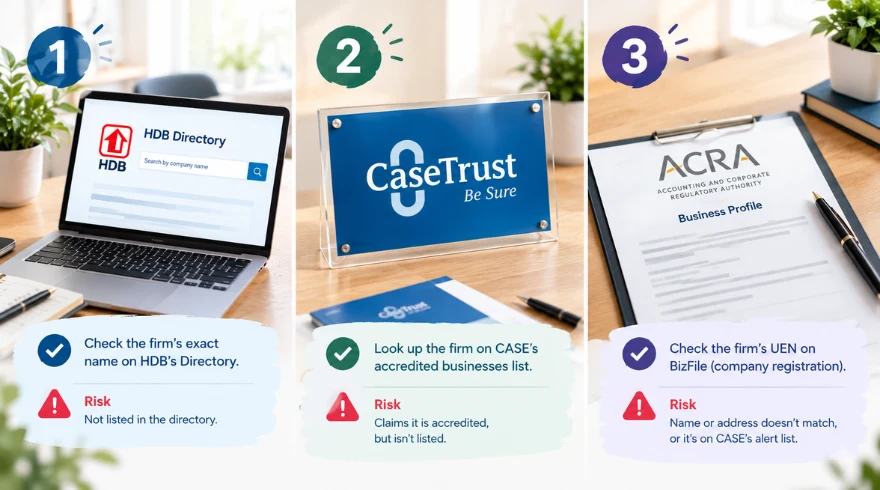
1. Check The HDB Renovation Contractor Directory (HDB Flats Only)
This check is for HDB flats. If you own a condo, skip ahead to check 2.
Start with HDB’s Directory of Renovation Contractors, or DRC. It is the official list of firms allowed to renovate HDB flats. Hiring an HDB renovation contractor who isn’t on it is an offence. Your permit also goes through a listed contractor, so you can’t get around the list anyway.
The list is useful, but it has limits. It tells you a firm is allowed to do the work. It doesn’t tell you the work will be good. HDB sees your deal with the contractor as a private matter. If you disagree about price, timing, or quality, you have to sort it out yourselves. So you have to check the quality. The list also doesn’t show how much experience a firm has. A firm with CaseTrust accreditation (more on that next) can join after 1 year of experience, while other firms need 3.
So think of the list as the first box to tick. Search the firm’s exact company name on HDB’s website, then ask the firm to confirm its listing in writing.
2. Look For CaseTrust Renovation Accreditation
A directory listing says a firm is allowed to work. CaseTrust adds what the listing leaves out: protection for your money.
CASE, the Consumers Association of Singapore, runs the CaseTrust renovation scheme. No law requires a firm to join, so not every firm does. CASE checks firms that join and requires them to follow its rules. For a renovation firm, those rules include:
- a deposit performance bond, which protects your deposit if the firm closes down or goes into liquidation before the work is done
- a first payment of no more than 20% of the total cost, with the rest paid in stages
- a 12-month warranty on the firm’s workmanship
- your written agreement before any change to the work
One catch: CaseTrust has more than one tier. These rules are for its main renovation scheme, so ask which tier a firm holds.
CASE’s 2024 figures are worth a look too. About 97% of renovation complaints that year were against firms without CaseTrust, and CASE said every case of lost prepayments or deposits involved one of those firms. In 2025, renovation complaints fell to 787 and prepayment losses dropped by about 74%, which CASE linked partly to more homeowners choosing CaseTrust-accredited firms.
3. Verify The Company On Bizfile And CASE’s Lists
Anyone can use these lookups.
- CASE’s accredited list:
If the firm says it is CaseTrust accredited, search its name on CASE’s accredited list to confirm. Also check the CaseTrust Watchlist. It names firms that were suspended or expelled, or that used the logo without permission.
- Bizfile:
This is the government’s business registry, run by ACRA. Search by company name or UEN (Unique Entity Number, the ID every registered business has). It shows whether the business is still live (not closed down) and its registered address. No login needed. Check that the name and address match your quote.
- CASE’s Company Alert List:
This lists companies CASE has received complaints about. It isn’t complete, so a firm missing from it isn’t automatically in the clear. A firm on it deserves a close look.
If a firm clears these, it is a real, registered business. CASE hasn’t flagged it, and any accreditation it claims is genuine. Now for the money: how much you pay, and when.
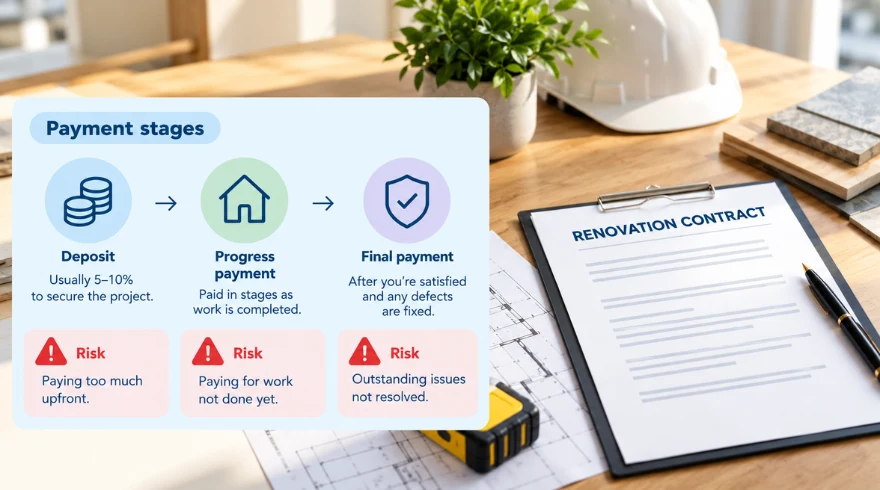
4. Check The Deposit And Pay In Stages
Tie each payment to work that’s actually done. That keeps your money from getting ahead of the job. CASE and the Competition and Consumer Commission of Singapore (CCCS) give the same advice: get the terms in writing and avoid large upfront payments.
With a CaseTrust firm, the 20% limit from check 2 means the first payment can be at most S$10,000 on a S$50,000 job. Two more protections apply:
- You get a receipt with full details for every payment.
- If the firm closes, you can claim the unused portion of your deposit.
The 20% limit isn’t a law, and it only binds CaseTrust firms. Still, a first payment far above 20% from any firm is a reason to ask why.
Save the final payment for last. CASE advises getting every defect fixed before you pay the full amount.
So before the last payment, walk through the home with the firm and list every defect in writing. Agree in the contract that the final payment is due after the firm fixes those defects. Then ask how your 12-month warranty is tied to payment, so you know the rules before you start.
5. Ask For The CaseTrust Standard Renovation Contract
Ask for the CaseTrust standard contract by name. A good contract tells you and the firm exactly what will be done, and by when. Accredited firms must use CASE’s standard contract and give you a signed copy. If a firm isn’t accredited, ask whether it will agree to the same terms.
Before you sign, find these in writing:
- Scope and drawings: What is being built, and where, with plans attached.
- Dates for each stage: Not just a finish date.
- Late finish: What the firm pays you for each week it runs late. Make sure there is a figure, not a blank.
- Defects period: How long after handover you can report problems for the firm to fix.
- Changes: Any change to the work needs your written agreement first, with the extra cost stated.
- Stopped work: How many days with no work on site before you can end the contract.
- Disputes: Who steps in first if you disagree. CaseTrust firms must attend a CASE mediation session if you ask.
If any line in the contract is left blank, get it filled in before you sign.
6. Compare Three Itemised Renovation Quotations
Get three quotes, and give each firm the same list of work so the quotes match. Ask each to itemise everything, with every item listed and priced separately. Lump-sum quotes are hard to compare and hard to check later. CaseTrust firms must show clear pricing breakdowns and disclose extra costs, so this is a fair ask of any firm.
Compare two lines from a quote. Vague: “Carpentry: S$15,000.” Clear: “Wardrobe, 2.4 m wide, plywood frame, laminate finish, soft-close hinges: S$2,400.” The second one tells you what you’re buying and gives you something to check on site.
If one quote comes in far below the rest, don’t celebrate yet. Put all three side by side and look for what the cheap one leaves out. A low quote can simply be missing items the others include.
7. Confirm Who Handles HDB Permits And Building Rules
Once you have a quote you like, ask who does the paperwork. The answer depends on your home.
- HDB flat: If your works need an HDB permit, your contractor applies for it online, and you sign a form giving them permission. HDB also says your contractor should give neighbours written notice, up to 2 units away on all sides, at least 5 days before works start. You can check your permit’s status on HDB’s website.
- Condo: Each condo sets its own renovation rules, so ask the management office for them in writing before you sign anything.
Either way, ask the firm to put in the contract who files each form and who pays any fees.
8. Know How The Warranty And Defect Process Works
Before work starts, know how they’ll fix a problem. A CaseTrust firm provides a 12-month workmanship warranty, but it applies only under the terms in your contract. Read them first, and ask when the 12 months start and how to report a problem. If a firm isn’t accredited, ask for similar terms in writing.
If something goes wrong, the steps usually run like this:
- Take photos of the problem, as CASE advises, and tell the firm about it in writing.
- Give the firm the chance to fix it. Your contract may require this before you hire anyone else, so check.
- Expect action. A CaseTrust firm must fix defective work at its own cost within a time you agree on, and must resolve complaints within 21 days.
- If it stalls, ask for CASE mediation. CaseTrust firms must attend a session if you ask.
Keep your photos and messages in one folder. They are your record if you need CASE’s help.
9. See Finished And Live Renovation Work
Now look at what the firm has actually built. Ask to see two recent projects like yours, such as an HDB resale flat or a condo unit of a similar size. You can see how we lay out our completed HDB renovation projects as examples of what to ask for. Photos can look better than real life, though. So ask to visit one finished home, if the owner agrees. If the firm allows it, also visit a site where work is still going on. A live site shows how tidy the crew is and how the finishing looks before they cover it up.
Past clients can tell you things a brochure can’t. Ask the firm if you can speak to one. Ask them whether the final cost matched the quote, and how the firm handled problems after handover.
You can also ask whether the firm has a bizSAFE certificate. It is a workplace safety program run by the Workplace Safety and Health Council, with five levels. Ask which level the firm holds and how it keeps the site safe day to day.
10. Ask Who Does The Work: Interior Designer Vs Contractor
Finally, find out who will do the work. Ask which trades the firm does with its own workers and which it hires out. Ask who will be on site each day and who to call when something goes wrong. For an HDB flat, also ask whether the subcontractors are on the HDB directory.
The interior designer vs contractor question comes up a lot. The label matters less than the answers to these questions. A design-led firm may hire out all the building work, and a contractor may do no design at all. What you want to know is who answers for the finished work.
This is where many renovations go wrong. When the designer and the builders work for different companies, an on-site problem can turn into a blame game, leaving you in the middle.
At The I-Plan Studio, a renovation company in Singapore, we keep tiling, carpentry, and general works in-house to avoid this. Whichever firm you choose, ask how it splits the work.
Get these answers in writing, and you have covered all ten checks.
What To Do If Your Renovation Goes Wrong
Even with every check done, a job can still go wrong. In 2024, CASE said some renovation contractors became uncontactable partway through the work, leaving homes unfinished. When you pay and the firm then stops turning up, many Singapore homeowners call it a renovation scam. What to do next depends on what went wrong.
- The work has problems: Follow check 8 first: take photos, send a written notice, and give the firm a fair chance to fix it.
- The firm stalls, goes quiet, or closes: Contact CASE early. CASE can negotiate with the firm for you if you ask it to. It doesn’t always work. In the renovation prepayment-loss cases it negotiated from 2017 to 2023, CASE helped consumers recover about half of their money.
- You want a tribunal to decide: The Small Claims Tribunals hear renovation contract disputes. The limit is S$20,000, or S$30,000 if both sides agree, and it applies to the value of your claim. If your claim is higher, the Judiciary says you can waive the excess so the tribunal can hear it. For anything bigger, you may want legal advice.
Conclusion
Hiring a renovation firm means trusting someone with your home and your money, but you don’t have to do it blind. Make sure the firm is allowed to work on your home and has real protections in place. Read the quote and contract until you know what they’ll build, when, and what you will pay. Then ask who will actually do the work, and what happens after handover.
That is how to choose a renovation company in Singapore without guessing. Keep every answer in writing, and if a problem still turns up, you will have the records to sort it out.
If you’d like a firm that already ticks these boxes, that’s what we built The I-Plan Studio to be, around the worries this guide covers, from lost deposits to quotes that keep growing. We built it around the worries this guide covers, from lost deposits to quotes that keep growing. We’re listed in HDB’s directory and CaseTrust-accredited, so a deposit performance bond covers your deposit. You get a line-item quote, and nothing changes without your written approval. You see your home in 720VR before anything is built, and a 12-month warranty covers you after handover.
Don’t just take our word for it. Search our name on CASE’s accredited list (check 3 shows you where), then send us your renovation brief.
Frequently Asked Questions
How Much Does It Cost to Renovate an HDB Flat in Singapore?
Based on 2026 market benchmarks, renovating a new HDB BTO flat costs about S$36,000 to S$76,000, and a resale HDB flat about S$51,000 to S$90,000 or more. Resale flats cost more because older units often need hacking, rewiring and waterproofing. For condos, a new unit costs about S$40,000 to S$85,000, and a resale one costs S$65,000 to S$105,000 or more. Your costs depend on scope and materials, so keep a buffer for variation orders and other cost-adding changes.
Can I Use CPF To Pay For Renovation?
No. You can’t use CPF savings for renovation, improvement, or repair work on your home, so you will need your own cash. HDB’s upgrading programs are separate, and you can use CPF to pay for those.
When Should I Start Planning My Renovation?
If you’re waiting for a BTO flat, start browsing ideas about a year before you collect your keys, and start meeting designers about four to six months before. Finding a designer or contractor before you collect the keys gives you time to compare quotes without rushing.
How Long Does A Home Renovation Take In Singapore?
From our own projects, most HDB renovations take about 10 to 14 weeks from the start of work, and condos usually take 12 to 16 weeks. The exact time depends on scope and how much carpentry is involved. Planning, quotes and permits come before that, so ask for stage dates in your contract.
What Time Can Renovation Work Be Done In An HDB Flat?
HDB allows general renovation work from 9 am to 6 pm on weekdays and Saturdays. Noisy work, like hacking walls, cutting tiles, and heavy drilling, is allowed only from 9 am to 5 pm on weekdays. No work is allowed on Sundays and public holidays, and noisy work is also barred the day before major holidays, such as Chinese New Year. Condos set their own hours.